
World's Largest Impulse Hydropower Generator Completes Rotor Hoisting
The world's largest impulse hydropower unit completed its rotor hoisting at the Datang Zhala Hydropower Station in Southwest China's Xizang Autonomous Region on August 11.
This milestone marks China's entry into the world's leading ranks in core technologies for ultra-high-head, large-capacity impulse hydropower equipment, giving strong impetus to the construction of the clean energy base in southeastern Xizang. The successful rotor hoisting signals the final stage ahead of the project's commercial operation.
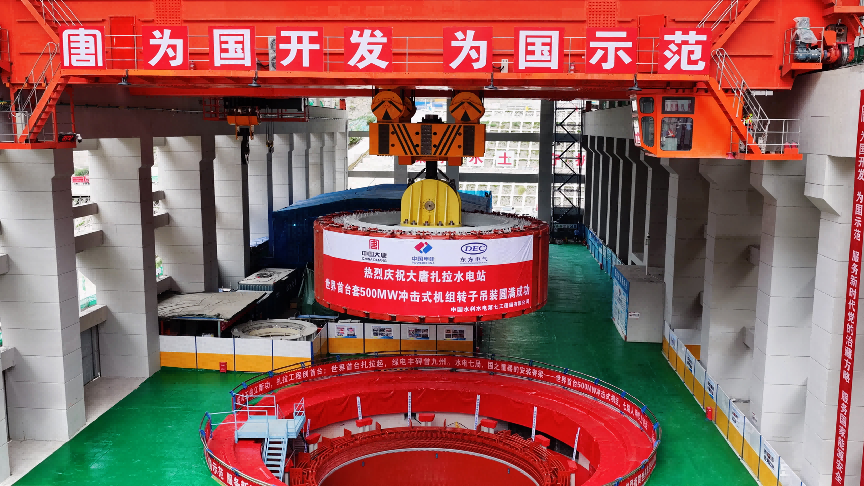
Rotor hoisting site at the Datang Zhala Hydropower Station
The rotor hoisted weighs approximately 840 tons, equivalent to the combined weight of 560 sedans, and serves as the "power heart" of the generator that drives energy transition.
On the snow-covered plateau, the project team overcame multiple extreme challenges, including high-altitude cold, hypoxia, the massive size of the component, and stringent precision requirements, to successfully complete this enormous yet delicate hoisting operation.
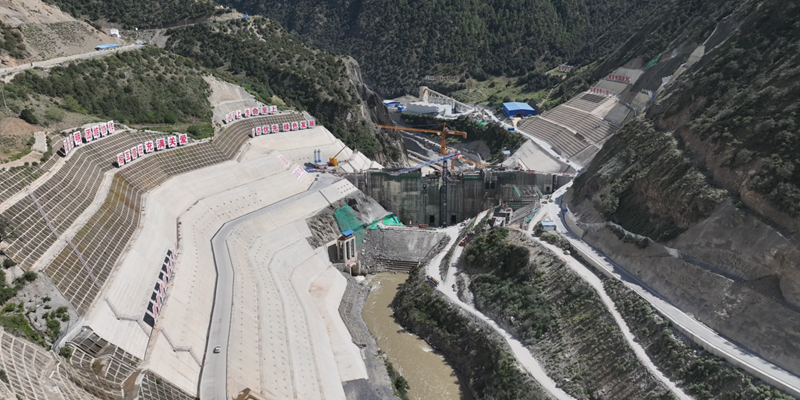
An aerial view of the Datang Zhala Hydropower Station dam
As the impulse hydropower project with the highest comprehensive construction challenges currently underway in the world, the Datang Zhala Hydropower Station shoulders the mission of safeguarding China's energy security.
The successful rotor hoisting of the project has broken the long-standing foreign technological monopoly in high-head, large-capacity impulse hydropower units, setting a new benchmark for intelligent manufacturing in China on the world hydropower stage.
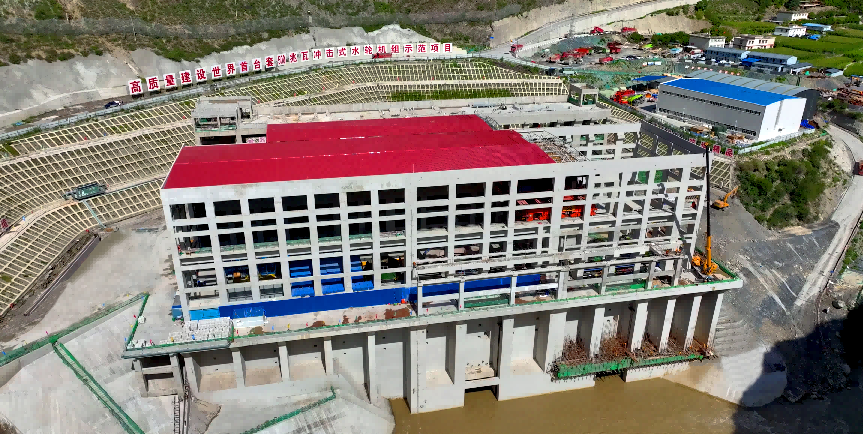
An aerial view of the Datang Zhala Hydropower Station powerhouse
The hydropower station is a backbone project for transmitting electricity from Xizang to other regions, and a key power source for China's national-level clean energy demonstration base that integrates hydro, wind, and solar resources in southeastern Xizang.
It carries the mission of building a national clean energy demonstration base, a renewable energy utilization demonstration zone, and a new-type power system demonstration zone. The station also plays the critical regulating role of "stabilizing wind and solar with hydropower."
Once completed, its electricity will be transmitted directly to the Guangdong-Hong Kong-Macao Greater Bay Area via ultra-high-voltage channels, serving as a core pivot in the upgraded "West-to-East Power Transmission (Xizang-to-Guangdong)" strategy and bearing the national mission of building a new-type power system.
Once fully operational, the station will provide nearly 4 billion kilowatt-hours of green electricity from the plateau annually, saving 1.3 million tons of standard coal and reducing carbon dioxide emissions by 3.42 million tons.
The project will provide a replicable and scalable "Chinese model" for the green transformation of traditional energy, with profound strategic significance for safeguarding national energy security, serving the "dual carbon" strategy, and promoting high-quality regional economic and social development.

